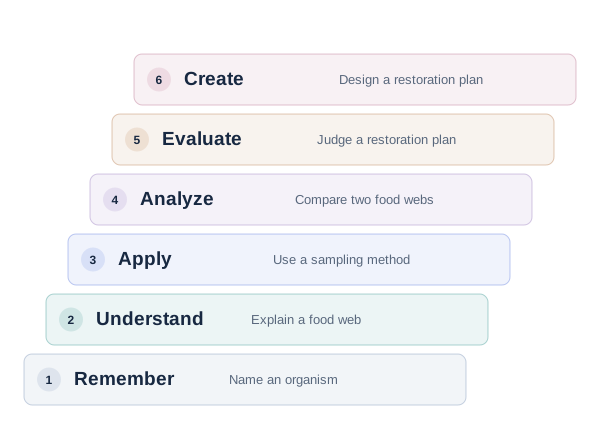
1Remember
Retrieve something you have learned: a fact, a term, or a procedure.
A practical learning hub for turning what you hope learners will understand into what they can actually do.
Explore the six levels of the revised taxonomy, find an action verb, and build a learning objective you can teach and assess.

Bloom’s taxonomy is a framework for describing the thinking a learning task asks for. The revised cognitive taxonomy names six processes: Remember, Understand, Apply, Analyze, Evaluate, and Create. It helps you make an objective, a learning activity, and an assessment ask for the same kind of work.
“Pond ecosystems”
“Explain how a change in one population affects a pond food web.”
This guide focuses on the cognitive domain. Attitudes, values, and physical skills also matter in learning; these six categories do not describe every educational goal.
Keep the topic fixed and notice what changes. Select a level to see the thinking and the evidence it would leave behind.
Label the producer, consumer, and decomposer in a provided pond food web.
What makes it Remember? The labels show recall of ecological roles. Learners are not yet explaining the relationships.
Explain how a decrease in pond plants could affect the animals in a given food web.
What makes it Understand? The explanation connects a change to its consequences, rather than repeating the names of organisms.
Use the provided sampling procedure to estimate the number of pond organisms in a new sample.
What makes it Apply? The learner carries out a method. Inventing a new sampling method would ask for a different kind of thinking.
Compare two pond food webs to identify which relationships could explain their different responses to drought.
What makes it Analyze? The comparison reveals relationships that explain a pattern. Simply listing differences would not establish the same demand.
Recommend one of two pond-restoration plans, justifying the choice against biodiversity and cost criteria.
What makes it Evaluate? A preference becomes a reasoned judgment when the learner weighs evidence against stated criteria.
Design a pond-restoration plan that addresses two threats and explains how its impact could be monitored.
What makes it Create? The learner develops a coherent solution within constraints. Copying an existing plan would not show the same process.
These are writing prompts, not fixed classifications. Read the whole task: its content, conditions, and expected evidence.7
Retrieve something you have learned: a fact, a term, or a procedure.
Make meaning by explaining, interpreting, classifying, or summarizing.
Carry out a procedure in a given situation, familiar or new.
Separate material into parts and work out how those parts fit together.
Make a judgment and support it with criteria and evidence.
Bring elements together into a new, coherent plan, explanation, or product.
The verb opens the door. The task sets the demand. “Compare” might ask learners to notice obvious features, or to analyze relationships. “Create a list from memory” is still recall. Choose the thinking first, then choose words that make it observable.
The original handbook grew from a group of educational measurement specialists working with Benjamin Bloom. The revision, edited by Lorin Anderson and David Krathwohl, updated the framework for learning, teaching, and assessment.12
Noun labels become verbs. Knowledge’s recall aspect becomes Remember; Comprehension becomes Understand. Synthesis becomes Create and moves after Evaluate.
The revision separates what knowledge learners work with from what they do with it. It also allows overlap between categories, rather than requiring a strict sequence.3
Why use the revision? Its action labels and two dimensions make it useful for planning observable learning and checking alignment. The original still appears in curricula and research; name the version you use, especially when comparing studies.
The 2001 revision is two-dimensional. Pair a cognitive process with the kind of knowledge it works on.
Examine how the relationships in a food web explain a change.
A taxonomy category is not a measure of task difficulty or learner ability. An unfamiliar recall task can be hard; a well-practiced design task can feel easier. Plan with the learners’ prior knowledge in mind.
Download the six-process diagram · SVGStart with the evidence you want learners to produce. Then make the action, content, conditions, and standard clear enough to guide teaching.
“Understand water quality.”
What would count as understanding?By the end of the workshop, recommend one of two water filters using the supplied test results, justifying the choice against cost and water-quality criteria.
What will learners do with the content? Use one main action where possible. Split outcomes that need different teaching or assessment.
With a source, a case, a tool, or without assistance? Include conditions when they change what success means.
A correct procedure, a design meeting constraints, or a judgment supported by evidence. Use a rubric when quality needs more than a count.
If the goal is to evaluate, let learners practice evaluating and assess a reasoned judgment. A recall quiz alone will not show it.
The same approach works in school, higher education, and workplace learning. For example: “Demonstrate the equipment shutdown procedure using the safety checklist, completing every critical step.” The context decides the appropriate demand.
SMART is a separate writing aid. In LOGEN, it means Specific, Measurable, Achievable, Relevant, and Time-bound. Use the questions below to improve a draft, then check that the result still represents worthwhile learning.
Name the learner action and its content: compare two local water samples, rather than “learn about water.”
Choose evidence you can inspect: a labeled diagram, a reasoned recommendation, or a correct demonstration. A rubric can be more useful than a percentage.
Check prior knowledge, available support, resources, and time. A verb cannot tell you whether a task is realistic for your learners.
Connect the work to the unit’s purpose and the learners’ needs. Why is this performance worth learning?
Decide when learners should be able to show it. A shared lesson or unit timeframe can supply this context; you need not repeat it in every sentence.
George T. Doran introduced the acronym in a 1981 management article. His terms were Specific, Measurable, Assignable, Realistic, and Time-related. Later adaptations use different words, including the version above. SMART did not originate in Bloom’s taxonomy.4
Doran treated it as a guide and cautioned against forcing every objective into numerical measures. For learning, a clear criterion can be qualitative: an argument using credible evidence, or a design meeting a brief.
Three quick checks. Choose an answer to see the reasoning. These practice choices stay on this page and disappear when you leave.
The value is in the decisions the framework helps you make: what to teach, what learners practice, and what counts as evidence.
Evaluate a restoration plan against criteria.
Weigh two plans and discuss the trade-offs.
Recommend a plan and defend it with evidence.
Biggs’s constructive alignment connects intended performances with teaching activities and assessment. Bloom’s can help describe those performances; alignment still depends on what learners actually do.5
Crowe and colleagues developed the Blooming Biology Tool and used it in three collegiate settings to examine questions, adjust instruction, and help students work with more demanding study questions.6
These sources support thoughtful planning and describe applications. They do not establish that adding a Bloom verb or a SMART checklist by itself improves learning in every context. Look at learners’ work, accessibility, feedback, and progress as well.
Remember, Understand, Apply, Analyze, Evaluate, and Create. They describe cognitive processes: retrieving knowledge, making meaning, using procedures, examining relationships, making judgments, and producing something new.
The 1956 cognitive taxonomy used Knowledge, Comprehension, Application, Analysis, Synthesis, and Evaluation. The 2001 revision used verb labels, placed Create after Evaluate, and separated the knowledge dimension from the cognitive-process dimension.
A verb is a starting point, not a classifier. The content, conditions, familiarity of the task, and evidence expected from learners determine the cognitive demand. The same verb can appear in tasks at different levels.
No. Choose the processes that serve the learners and the purpose. Accurate recall and fluent use of a procedure can be important outcomes. The revised categories overlap; they are not six compulsory steps in every lesson.
No. Bloom’s taxonomy describes kinds of thinking and knowledge. SMART is a separate objective-writing aid, originating in George T. Doran’s 1981 management article. LOGEN uses Specific, Measurable, Achievable, Relevant, and Time-bound.
No. Evidence can be a justified interpretation, a design meeting constraints, a performance judged with a rubric, or a correct procedure. Use numerical thresholds when they have a defensible meaning, rather than adding an arbitrary percentage.
Start with Krathwohl’s overview for the revision, Doran’s article for SMART, and the applied research for how these ideas inform teaching. Publisher access can vary.
The original handbook, edited by Benjamin S. Bloom; Longmans, Green. The history and categories are also discussed in Krathwohl’s overview below.
The revised handbook; Longman. Read alongside the accessible overview by its co-editor below.
Theory Into Practice, 41(4), 212–218. The changes, overlapping categories, and two-dimensional taxonomy table.
Article DOI (opens in a new tab)Management Review, 70(11), 35–36. The original management article; linked scan hosted by EVAL.
Original article · PDF (opens in a new tab)Higher Education, 32, 347–364. Aligning intended performances, learning activities, and assessment.
Article DOI (opens in a new tab)CBE—Life Sciences Education, 7(4), 368–381. A discipline-specific tool for analyzing assessment and supporting study strategies.
Open article DOI (opens in a new tab)Education Sciences, 6(4), 37. An analysis of 30 published verb lists and the limits of verb-based classification.
Open article DOI (opens in a new tab)In LOGEN AI, describe your learners and topic, choose Bloom levels, and generate suggestions or write your own. Add and edit objectives one at a time. Mark the ones you want checked as ready, then run a separate AI review for SMART criteria, cognitive demand, coverage, and learner fit.
You decide what to keep and revise. AI feedback is a judgment to consider, not evidence that learning has happened.